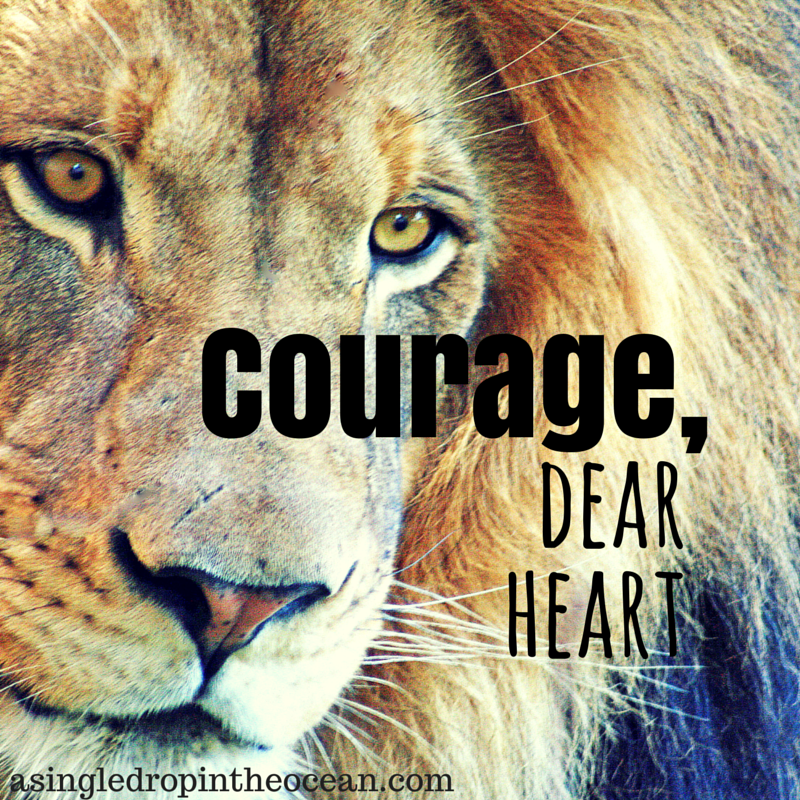
Courage, dear heart

Courage Dear Heart by Laura at A Drop in the Ocean

Let’s be real, folks. Our world is a molten hot mess of depravity right now.

I’ve kind of wanted to go cry in a corner at various times over the last couple months and ignore the world. I did actually get off of the internet for a couple days because I had just had enough. It’s exhausting to see this all going on, and frustrating at times having little control to change it. Sometimes it feels like talking to a brick wall because the conversation has lulled. Either people have spoken their minds, or people choose to remain removed from the issue.

Now the waters seem to have settled after the initial shock. We’ve written about the Planned Parenthood videos and gay marriage being legalized, shared our disgust, and now mostly gone back to our everyday lives of getting by.

We have become accustomed to evil.

At the same time, we know this all is horrible.

But it’s also the norm.

So what in the world are we supposed to do?

If you think back to the holocaust or slavery or the civil rights movement – all social issues of their times – society didn’t change when people got sad. Society didn’t change because people found out about bad stuff happening. Plenty of people had to have known about those atrocities.

The world changed because a brave few had enough guts to stand up, expose evil, and demand the atrocity that was going on be stopped.

No one person is probably going to change the world (#RealityCheck). But what if instead of allowing ourselves to hide in a corner and go back to our ordinary lives, we let the gravity of this time sink in and radically change us?

What we if we actually decided that enough is enough?

That the truth we believe in is worth defending at all cost?

That our reputation doesn’t matter when it comes to defending the life and dignity of the vulnerable?

Now THAT would stir things up.

Many of us who believe in truth and morals are used to being the minority. Obviously. We expect to be told we’re wrong. We expect the media to misinterpret us and belittle us. We know our religious liberty is at stake. We know Christian morals are no longer the law of the land.

But you know what? We’re not victims here.

I am not a victim.

You are not a victim.

Certainly we’re affected by our life circumstances. But life is how we respond to whatever is thrown at us. Though we may want to hide in a corner sometimes, we can’t. Too much is at stake. And if we did, who would be changing the world?

I think we keep things quiet because we are more scared of standing up for ourselves than we are of bad things happening to other people.

And that just won’t do.

We are called out of comfort to stand witness to the beauty, truth, and goodness that is our faith. We are equipped by our Mother Church who gives us the foundation to articulate the dignity of life and love as God intended. We are called to profess the goodness of every human person, not to simply go on living our own isolated lives. Life is about more than our little lives.

In these moments when we tire of “the issues”, we have to remember that it’s not people we’re fighting. It’s principalities and evil (Ephesians 6:12). And God’s go our back, guys! It’s not just us against big, bad people who are out to get us. We are facing deep-seated evil, and moral relativism unlike the world has seen in a while. This is our opportunity to do more than talk, to substantially make changes in our communities and families to support the dignity of the human person.

This is where we show the world who we are.

This is where we have to radically put our trust God, because we cannot fight evil with our littleness. But love conquers all. Love has already won thousands of years ago on the cross. Do you believe that? Do you trust in him who created you for such a time as this? Because he created you for a purpose. Living at this time is part of the plan.

We have to trust HIM, because we cannot do this ourselves. It simply can’t be done. And that is frustrating. We are troubled because these atrocities are terrifying and we can’t control everything going on. But we can rest peacefully knowing God has it under control.

If we allow God to use us to create a better world, and give him all of our weaknesses to transform, there’s no telling what he will do through us.

As Aslan would say, take courage, dear heart. You are on the side of love and life. You belong to a people of God that evil is in the midst of a reckoning with. The battle is rough and the soldiers are few. But we are mighty. We serve God who loves and equips each of his children for the purpose we were created for. And spoiler: truth always wins.

To Life,

signature

P.S. Connect with me on FacebookTwitterPinterestBloglovin’ or by email.

Photo courtesy of Lori Branham on Flickr and is used in accord with it’s license without necessarily representing the views of the photographer.

Daring to face the giant

How dare she sit there eating salad and sipping wine while nonchalantly talking about crushing babies?

I don’t know how someone could be so callous. 

She’s going to rot in hell for everything she’s done. Good. She deserves it.

These, and worse, are what I’ve heard many people say about Dr. Nucatola – Planned Parenthood’s Senior Director of Medical Services – recently pictured in a viral video. The video shows her talking over dinner about Planned Parenthood’s practice of passing body parts of aborted babies on to mediator-type organizations which then transfer them to medical research labs.

The video revealed a horrifying practice especially to those who had never heard about this before.

But it’s interesting to see how people respond.

Many people are incredulous at how an organization can do such a thing. They take their anger and disgust out on this woman. The anger and disgust is understandable, but personally attacking this woman does not help. Because guess what…

We ask how dare she do this. How dare she abort babies and crush skulls and manipulate how abortions are done to produce prime body parts?

Yes, how dare she.

But how dare we neglect to stop this. How dare we stop talking about it. How dare we go on with our daily lives as if nothing is different. How dare we avoid big topics in order to continue our comfortable lives?

Jenny’s post on this topic resonated with me because like her, this news did not surprise me. I have heard about this before. It did not emotionally jar me or make me cry. It did not break my heart.

And that disgusts me.

I am so used to hearing about attacks on human dignity and life. I am so used to people not being valued. I am so used to hearing about people being killed that it doesn’t phase me anymore. Don’t even ask me to watch a horror movie or go in a haunted house. But babies being ripped apart? Yeah, that’s happening. People being beheaded? Oh yeah, that ISIS thing has been going on for a while.

But THESE ARE HUMAN LIVES WE’RE TALKING ABOUT!

As someone who talks about the dignity of every single unrepeatable life, how do these stories not have a huge impact on me? How am I not sobbing at the thought of innocent lives being literally ripped apart?

You know, I don’t have a great answer. But I GET what Jenny said:

When I was younger I used to wonder about the German people and why nobody tried to get out ahead of Hitler, how an entire nation could have fallen under his evil spell.

Now I know. Now I see, firsthand, that none of us are immune to the horrors of our day. And that as the temperature rises, the frog slowly cooks, oblivious to his own imminent peril as the mercury creeps ever upward. And that at a certain point the human mind, when confronted with such appalling and obvious wickedness, shuts down or short circuits in cowardice or fear or apathy or, or, or …

I get it. I am so used to evil that it’s the norm.

I am the reason we still have abortion.

We all are.

Because we’re used to it and don’t fight it anymore. We accept that we’ve lost before the battle is over.

God, save us from our own blind selves. And renew in us the conviction to bring your light to a horribly fallen world. If we don’t speak up, nobody will. 

Time to buckle up, friends. We’re in this war for the long haul. There is a giant Goliath of evil looming around us. But I have good news, and a bit of a spoiler: love, life, and truth ALWAYS win.

To Life,

signature


P.S. Connect with me on FacebookTwitterPinterestBloglovin’ or by email.

6 non-religious reasons to oppose gay marriage

This post is part of the Love Wins series – a series of posts covering topics within the issue of gay marriage (post 1, post 2post 3, and post 4). The goal of these posts is not to convince anyone to think what I think, but to create a conversation and explore the topics together. I am not an authority figure on this issue, and will not always approach this from a highly academic perspective, but am writing as a Catholic young voice seeking the truth. I hope you’ll follow along and be part of the conversation!

Love Wins A series on gay marriage


While my faith is very important to me, not everyone shares my beliefs. I think it’s important in this series to include non-religious reasons why legalizing gay marriage might not be the best idea.

Here are 6 reasons to think about:

1. In moving away from traditional families, we move away from traditional values.

Duh, that’s the whole point, right? Some people count this as progress. And of course we should always learn and become better and develop as a world. But in moving away from traditional families, we’ve become relativistic. People say it just doesn’t matter what anyone does. But anything that encourages a departure from absolute truth is problematic.

2.  There are two different genders for some reason, and I’m going to go out on a limb and say it’s to propagate the species. 

I guess this is good news for people who think the world is overpopulated. I mean, more gay marriage, less people born, right? Well, many countries, including the U.S. are below a replacement level of fertility rate. That means we’re going to have more and more older people with less and less younger people to care for them. That doesn’t sound like a good economy.

3. STD’s are more prevalent among those who are in sexual relationships with a person of the same gender. 

Ever wonder why they ask you when you’re donating blood whether you’ve been in a sexual relationship with someone of the same gender? According to the CDC, “75% of primary and secondary syphilis cases in the United States” are among men in sexual relationships with other men. These men are 17 times more likely to develop anal cancer. This doesn’t sound like a normal and healthy lifestyle.

4. Children are entitled to a mother and a father.

Yes, two people of the same gender are capable of raising a child. But the balance between the differences mothers and fathers provide is not replaceable with two people of the same gender. Some people say it’s not important to have both, that it doesn’t matter. But two parents of the same gender cannot provide the same environment of a traditional family structure.

5. It purposefully deprives children of their biological parents.

Adoption is a beautiful and courageous thing to do. But when two people of the same gender want a child who is not adopted, they have to use a donor. There are too many articles to link here that say what a problem egg and sperm donation is. It’s a hugely unregulated industry I certainly wouldn’t want to encourage people to be part of. As people get older, adopted children or children conceived using donors often want to know their biological parents. Often times nowadays, it’s impossible with anonymous donors.

6. We do not have enough evidence to say that children growing up with homosexual parents do not have any problems down the road.

According to one study, children of homosexual parents:

-Are more likely to be currently cohabiting
-Are almost 4 times more likely to be currently on public assistance
-Are more than 3 times more likely to be unemployed
-Are nearly 4 times more likely to identify as something other than entirely heterosexual
-Are 3 times as likely to have had an affair while married or cohabiting
-Are 10 times more likely to have been “touched sexually by a parent or other adult caregiver.”

That’s just one study. We need a heap more research to know what the long-lasting repercussions are before we say all families are equal.

The fact is that besides philosophical and theological reasoning, there are plenty of reasons why a sweeping decision to legalize gay marriage is highly problematic. I hope you’ll continue to follow along as we wrap up this series looking at a few more topics!

Connect with me on FacebookTwitterPinterestBloglovin’ or by email to follow along during this series. And help spread the conversation by sharing this post!

Be sure to check out post 1, post 2post 3, and post 4 if you haven’t already!

To Life,

signature


Image via Hartwig HKD on Flickr.

Tips for proceeding in the battle for marriage

This post is part of the Love Wins series – a series of posts covering topics within the issue of gay marriage (post 1, post 2, and post 3). The goal of these posts is not to convince anyone to think what I think, but to create a conversation and explore the topics together. I am not an authority figure on this issue, and will not always approach this from a highly academic perspective, but am writing as a Catholic young voice seeking the truth. I hope you’ll follow along and be part of the conversation!

Love Wins A series on gay marriage


In the immediate aftermath of the recent decision by the supreme court, I was mostly relieved to see that people I know weren’t being haters on social media. As time went on, though, some things came up that kind of made me cringe.

Exhibit A: Comparing gay people to unborn babies (or vice versa, or comparing the issue to abortion at all)

Exhibit B: Whining about being a victim

Exhibit C: Trying to prove your point with a fancy graphic.

facebook_1436124268127

Here are some pointers for people who stand behind traditional marriage on how to not be a crazy person moving forward:

1. Be a witness to the truth about love and marriage. It’s not all butterflies and unicorns, but it’s always worth it. Unless people can see that through you, posting articles and saying things isn’t going to help very much. Actions speak louder than words.

2. Educate yourself. Knowledge is power. Literally. You’re representing a lot of people, so represent well! I recommend reading a lot, paying attention to laws and studies, and becoming well versed in the why behind our beliefs.

3. Defy the stereotype of bigot and homophobe by . . . not being a bigot or homophobe. Love people, even if they disagree. And if people call you names for just believing in traditional marriage, respond gracefully. Nobody can make you a bigot unless you’re actually being one.

4. Remain open to conversation. And make sure that when conversations come up, you lovingly offer what might be a unique perspective.

5. Listen to people’s concerns on both sides, and don’t discount them. Everyone needs to be heard, valued, and responded to lovingly.

6. Have more of a response than JESUS for why you believe what you do. Sure, you could quote the Bible, but how relevant is that to people who don’t share your Christian beliefs? This goes back to #1 and the need to be educated. We’ll talk more about it tomorrow!

7. Keep the hope alive. In the end, no person or legal institution can change the sacrament of marriage, or the biology of men and women. Our society is changing. The way traditional marriage is treated is changing. But have hope, and don’t despair! Know that God is all about second chances. No one is beyond His mercy and love. Let no one be beyond ours.

If you can’t already tell, I think the most important thing on both sides of this debate is to love our neighbors – even when we disagree. That’s why this series is called “Love Wins”.

Connect with me on FacebookTwitterPinterestBloglovin’ or by email to follow along during this series. And help spread the conversation by sharing this post!

To Life,

signature


Image via Hartwig HKD on Flickr.

Further reading:

5 Ways to Respond to the Supreme Court’s Decision on Same-Sex Marriage


The truth about tolerance

This post is part of the Love Wins series – a series of posts covering topics within the issue of gay marriage (post 1, post 2). The goal of these posts is not to convince anyone to think what I think, but to create a conversation and explore the topics together. I am not an authority figure on this issue, and will not always approach this from a highly academic perspective, but am writing as a Catholic young voice seeking the truth. I hope you’ll follow along and be part of the conversation!

Love Wins A series on gay marriage


People on both sides of the gay marriage debate are guilty of being mean. Plain and simple. Not everyone has been mean about it, but many people (including myself) have probably been guilty of airing an insensitive comment or two.

But this post isn’t about mean people. It’s about learning how to live around people who we disagree with on controversial, emotionally charged, issues. It’s about ordinary people confronted with a tough issue.

Ordinary people don’t usually want people to be mean to them. Nor do they go around looking for opportunities to be mean. However, even people who do their best to NOT say nasty things are accused of being intolerant bigot haters of love these days….or something along those lines. I’m talking mostly about supporters of traditional marriage. But on the flip side, some supporters of gay marriage have been subject to untrue accusations as well.

We all mostly want the world to be harmonious place, right? So it makes sense that we get mad at people who mess up our perfect plan for the world.

But we can and do broadcast our opinions and beliefs on worldwide platforms. It kind of makes me scratch my head when people start crying that someone disagrees with them after taking a stand for something. And it makes me sad that people are personally offended when a view other than their own is shared.

The thing is, putting your opinion out there is not inherently mean.

Having an opinion or belief does not mean you automatically hate people who don’t share your belief.

In the aftermath of the recent supreme court decision, I saw a friend post a lovely response article. And someone else literally commented “You are intolerant”. Like, what? Is having an opinion intolerant?

Or am I just expected to keep my mouth shut when I believe in something? 

And what does tolerance even mean?

Many people use it to mean “accepting behaviors you disagree with as as good for other people, even if you think they’re wrong”. It’s used as a synonym for agreement these days. If I don’t agree with a gay marriage supporter’s view, I’m a bigot, right? Well, no.

Case in point:

“We’ve redefined tolerance to mean never disagreeing. The real definition of tolerance is first disagreeing and then putting up with the people you disagree with. You have to disagree to start being tolerant.”

I have my beliefs because they are true to the best of my knowledge. And you know what? We all have different beliefs. We don’t all agree. And that’s part of life. We have to put up with it.  To strive to live together regardless of differing beliefs is what tolerance is all about. It’s not about agreeing with each other.

So here we are with different beliefs. I think you’re wrong about some things. You probably think I’m wrong about lots of things.

We don’t have to agree with each other.

But what we are obligated to do is to love each other anyway.

Every single person, regardless of beliefs, is worthy of respect and love. Nothing can change that. No matter what. Even when we have polar opposite beliefs. Our behavior should go beyond tolerance, even. I should not only tolerate you. I should love you. I want to love you, even if it’s hard. I want to be able to know and love people who are different than me, because love wins.

I’m not going to agree with everyone on everything, but love isn’t about agreeing. It’s about accepting a person as a creature with inherent dignity that nothing can change. I don’t have to accept your beliefs to love you. And I don’t have to share your position on gay marriage to be friends.

Tolerance is about doing your best to live in peace with people you are at odds with. I truly hope as our country moves forward that we can do a better job on ALL sides of keeping the peace.

We’ll talk more about this in an upcoming post on distinguishing between a person and an issue. Until then:

Connect with me on FacebookTwitterPinterestBloglovin’ or by email to follow along during this series. And help spread the conversation by sharing this post!

To Life,

signature


Images via Hartwig HKD on Flickr.

Further reading:

Disagreement is not discrimination