What’s up with all these Catholic “no’s”?

It’s been a while since I’ve gone to daily Mass. So today I got up and went to the church of many issues where one of the priests has rather edgy (as in not completely orthodox) homilies.

Today he talked about how the church is so full of “no’s” and how negative it really is and gosh darn it, shouldn’t we be exuding rainbows and butterflies? Okay, I added that last part, but you get the picture. He quoted the verse “I came that they may have life, and have it to the full” (John 10:10) and the quote “The glory of God is man fully alive”. Both of those are beautiful quotes, and ones which have depth far beyond the surface that he scratched on. He kept going on about how depressing our faith is.

I really wanted to stop him afterward and ask “Father, you were talking about how our faith is all full of ‘no’s’ but isn’t it also about some of the most beautiful ‘yes’s’ too? Isn’t that what the ‘no’s’ lead to?” But he was nowhere to be found when Mass was over. Darn.

So I thought about it more. Sure, being Catholic means saying no to many things. For example, being Catholic means saying no to (among many other things):

  • Abortion
  • Artificial birth control
  • Gay ‘marriage’
  • Intimacy before marriage

But, wouldn’t you know, God created us for far better things. By saying no to those things, we say yes to:

  • the beauty of the lives of each and every person
  • family sizes determined by God
  • balanced family lives lived out through natural law
  • pure and holy marriages centered on God

A truly authentic Catholic life shows the beauty of God’s ultimate design for the human person. He designed us to love and to be loved, and all of our “no’s” exist to lead us to Him. If we said yes to every human passion and appetite, we would be just like the rest of the world. But us? Us Catholics are different. We’re unlike the rest of the world because Jesus set us apart  to be the light of the world.

Instead of pushing aside these important topics, we need to confront them head on and live up to them. We need to show the world that our lives are different because of the yes’s these no’s lead to. And we are better because of it.

Gay Marriage & DOMA: What’s not to love?

This morning when I woke up, I was thinking about the outcome of SB5 in Texas (did you know they called for a second special session?) and the huge impact the Supreme Court decision on DOMA and Prop 8 could have. When I got online, there were all sorts of things people were saying about DOMA and Prop 8: some people were calling this a historic moment, and others sounded defeated. But in fact, it is not the day for either.

The court basically dismissed Prop 8 (which CA voters voted for twice) and we’ll see what happens with this. The court is now on the books as ignoring the voices of millions of CA voters (7 million, I heard).

The significant decision on DOMA confused a lot of people, myself included. Was gay “marriage” legalized? What are the repercussions? What happened (as far as I’ve read) is that the Supreme Court decided to basically leave it up to the states. They didn’t re-define marriage across the board, contrary to what many people are saying. States that do not recognize same-sex “marriage” are not going to be forced to recognize even the legally accepted unions of other states. The parts of DOMA that were struck down were “limited to only those marriages already recognized in the states that allow same-sex marriage”.

There is much more to learn about what this means for America, and I’m sure more information will become available in the coming days.

These rulings are not a reason to have a pity party or a hernia. While this is not encouraging news, it’s actually not the end of the world. I’ve been thinking about this all day and trying to put my thoughts into words. This is my attempt.

Gay “marriage” is not an issue that is going to be swept under the rug soon, or something that we’ll stop talking about. So I wanted to share more of my own viewpoint on this issue with you so you can see where I’m coming from.

As a Catholic, I don’t ever want to see gay “marriage” recognized as valid. It’s not because I hate gay people, or because I’m afraid of them. It’s because the Church recognizes the universal call to holiness, and urges all people to live a life ordered to our ultimate goal of heaven. This means that all people, regardless of sexual orientation, are called to comply with the demands of a chaste life.

Living a chaste life doesn’t mean you’re a prude. This is what it means:

As the Church says in the Catechism:

“Homosexual persons are called to chastity. By the virtues of self-mastery that teach them inner freedom, at times by the support of disinterested friendship, by prayer and sacramental grace, they can and should gradually and resolutely approach Christian perfection.” (2347)

“This inclination, which is objectively disordered, constitutes for most of them a trial. They must be accepted with respect, compassion, and sensitivity. Every sign of unjust discrimination in their regard should be avoided. These persons are called to fulfill God’s will in their lives and, if they are Christians, to unite to the sacrifice of the Lord’s Cross the difficulties they may encounter from their condition.” (2358)

“[T]radition has always declared that “homosexual acts are intrinsically disordered.” They are contrary to the natural law. They close the sexual act to the gift of life. They do not proceed from a genuine affective and sexual complementarity. Under no circumstances can they be approved.” (2357)

As a Catholic, I have a duty to support and uphold the teachings of the Church.

As someone who views marriage between men and women as a sacred institution, today is not the end, but it is a moment of clarification for me to sit down and really think about this. The movement to support traditional marriage is growing exponentially, and I am proud to support it.

CV-Supreme-Court-Marriage-400x533

And so, my friends, this is why I don’t want gay “marriage” legalized. I do hope that this opens the door for people to discuss these issues honestly and openly. I welcome any discussion you may be interested in.

BSA’s acceptance of gay scouts: Catholic or not?

Legit or not?

When the Boy Scouts of America (BSA) recently made the decision to allow “openly gay” young men to be scouts, at first I was sad to see that. I was mad. I thought, well gee, there goes another organization falling into the pressure given by society! But since then, I’ve had the opportunity to really think about it more. And I’ve realized I was wrong.

I’ve read many articles that basically said well, now we’re just waiting for boys to ask to share tents with their crushes, attempt to solicit bad behavior, and parade around flaunting their sexuality. To some degree, there’s a bit of truth there. Allowing homosexual boys to be scouts certainly provides an opportunity for that to happen. But it’s wrong to think that just because some of those things could happen, we shouldn’t have gay scouts.

You see, as a Catholic, I fall back on what the church says. And what does it say? It says that people with homosexual preferences “must be accepted with respect, compassion, and sensitivity. Every sign of unjust discrimination in their regard should be avoided. These persons are called to fulfill God’s will in their lives and, if they are Christians, to unite to the sacrifice of the Lord’s Cross the difficulties they may encounter from their condition.”

Is banning them from scouting unjust discrimination? I think it could be. After all, if we are to accept and embrace all people, shouldn’t any boy be allowed to be a scout? Looking at this from a Catholic perspective, I wouldn’t be comfortable answering that with anything but a yes. Of course gay scouts should be allowed. We shouldn’t exclude boys because of their sexual orientation.

BUT wait a second! you say. Isn’t this going to cause problems and make other boys uncomfortable? The truth is that I don’t know. It could happen. Will boys be subject to anything more than they would at school with gay classmates? Maybe. But like this article pointed out, there’s an obvious difference between what a Catholic troop would look like and what a more secular one would look like:

“The gay teen in a Catholic troop shouldn’t be sharing with his fellow Scouts his sexual attraction to other males. He can’t talk excitedly about bumping into his crush at the mall or hoping he’ll say yes to the prom. In fact, he can’t take a same-sex partner to a dance or on a date because he must strive to keep same-sex friendships non-romantic.” 

If troops follow the scouting rules and deal appropriately with any sexual issues (homosexual and heterosexual), then there’s no reason why this new rule should be an issue for Catholics. It’s actually good, from a Catholic perspective, to allow gay scouts. It’s what we’re supposed to do. We are to accept and embrace (you might use ‘tolerate’) our fellow human beings simply because we are made in the image and likeness of God.

Homosexual behavior, on the other hand, in an issue in and of itself. And this is where I blurred the issues before. Accepting gay scouts does not mean we need to tolerate immoral behavior – it simply means we accept the people. The Church has clearly outlined the Catholic perspective, and shows us the beauty of the call to chastity of all people with specific instructions for how that is to be carried out (those with same-sex attraction are included). If BSA’s recent decision does eventually give way to the tolerance of homosexual acts, then that’s another story for another day. But for now, carry on scouts.

On My Bookshelf: The Four Signs of a Dynamic Catholic

OnMyBookshelfOfficialPic

Welcome to On My Bookshelf – my blog series where I bring my bookshelf to your computer! Something I’ve learned at Benedictine is that we should be lifelong learners. That’s what this series is all about: encouraging you to be a lifelong learner through reading. Each post is in a question & answer format and will provide a link to the item on Amazon. All OMB posts can be found on the page up top. Enjoy!

The Four Signs of a Dynamic Catholic

By Matthew Kelly

Published by Beacon Publishing in 2012

216 pages


Why did you pick up this book?

Because I thought it would be interesting to learn about awesome people. I actually got this book for free after Allen Hunt (a former mega-church pastor now turned Catholic speaker) gave a talk at Benedictine and was handing them out. Plus the subtitle sounded pretty epic – who doesn’t want to change the world?

What topic(s) does this book deal with?

The four signs (which I’m totally not telling you – you have to read it), what they are, why they’re good, how they make a person dynamic, and how to develop them in yourself. I thought this was just going to be well, here’s how awesome people are kind of book, but it’s not. It delves into how you can personally develop the four qualities, which are all necessary in the lives of Catholics.

What was your favorite part of this book?

SO MUCH! I can’t pick one thing. I enjoyed how this book was short and sweet, and not a theologically drowning book (you know what I mean). The step by step suggestions for developing your own life were wonderful too.

What style is this book written in?

This book is informally written, almost like a conversation. It is not overly theological, which is refreshing and rare for such a Catholic book (yes, it has an imprimatur).

How readable is this book?

This book is an easy read, but even then, I took about a month to finish it. It was chock full of great information, and you need time to let it soak in.

Where can I get this book?

Click on the link below to purchase this book on Amazon!

The Four Signs of a Dynamic Catholic

Click here to buy it (free plus $6 S+H) from the Dynamic Catholic Institute.


I cannot recommend this book highly enough. It was enjoyable to read, and I learned so much from it. If you’d like to know more, or have a question about it, feel free to comment below or contact me!


Since I am an Amazon Associate, I will receive a small percentage of your purchase value if you use this Amazon link. I would very much appreciate if you did so that I can more easily bring new books to my bookshelf and to your computer. Thank you!

Lord, I am totally worthy

Imagine for a moment that Jesus was walking the earth again. Imagine you were in his very presence – the same room as him. How would you behave?

Would you ignore the fact you were in the presence of God?

Would you chat on your phone?

Would you go about your daily life even though you had this incredible opportunity to see God?

I hope not.

Then why, tell me, do we do these very things?

When I went to Mass at my college this past school year, it was refreshing to be surrounded by young people who respectfully attended on a regular basis. For the most part, Mass-goers would come on time, act reverently toward Jesus in the Blessed Sacrament, and participate appropriately in Mass. We knelt during the parts I’ve grown up kneeling to (and in one of our chapels, the students regularly forego the kneeler to kneel on the hard ground).

I got used to this.

When I came home for the summer just a few weeks ago, I was shocked (though how can I really be?) to see the lack of this behavior in my own home church. Let me re-state that. My home church is not terrible. It’s actually one of the best I’ve been to. We go to a different (closer) church for Mass during the week, which, on the other hand, is scary. Let me elaborate.

At my home church, we have perpetual adoration. That means whenever Mass is not going on, the Blessed Sacrament is exposed (ie. God is visibly present). He is exposed until a few minutes before Mass when the curtains are drawn. When people came in for Sunday Mass a couple weeks ago, I was struck by the number of people who did not genuflect before entering their pews. I know I shouldn’t really be noticing this while praying before Mass starts, but it was hard to ignore the fact that so few people genuflected. It’s something I was always taught to do.

At the church we go to during the week (which is much closer to home), it is sad to write down everything we’ve seen:

  • The walls are clear glass windows surrounding the circular building which has cushioned chairs instead of traditional pews
  • No kneelers
  • Closed tabernacle shoved to the side
  • The Blood of Christ is consecrated IN the glass pitcher (for lack of better word) and THEN poured into separate glasses. The glass pitcher – which has contained the sacred species – is then casually handed down an assembly line of lay women.
  • After consecration, the priest steps back as lay women come up on the altar to divide the Eucharist and Blood of Christ into the respective containers. He stands back watching as this is done.
  • One priest in particular likes to applaud the choir after Mass
  • The same priest likes to sing “Happy Birthday” to anyone who’s celebrating before giving the final blessing

Now, no one is perfect. We are all far from the ideal person we’re called to become. But these are serious issues we either do not care to address, are ignorant of, or willfully ignore. It’s time that came to an end.

Because I’ve grown up in a family that attends conservative Masses, I am used to what I would call “proper” Mass behavior. But does that make it right? Even though it’s what I prefer, I decided to research it for myself to see what the Church itself says.

Before reading on, please note that CCC stand for the Catechism of the Catholic Church, and GIRM stands for the General Instruction of the Roman Missal. Both are authoritative texts of the Catholic Church.

Genuflecting & Bowing
genuflect

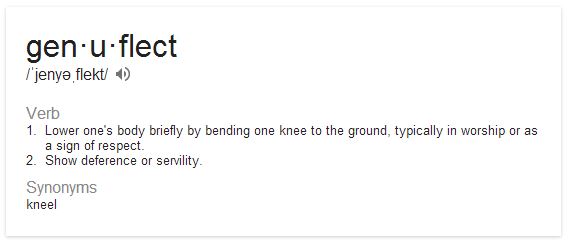
In my home church, I’ve noticed how many people neglect to genuflect before entering their pews, so today I decided to count. Of the people I observed entering their pews today, 33 did not genuflect and 5 did genuflect. None bowed. I was taken aback by these numbers, and rather shocked that roughly 1/8 of the people I observed paid Jesus any sign of respect before entering their pew.

CCC says:

1378 -“In the liturgy of the Mass we express our faith in the real presence of Christ under the species of bread and wine by, among other ways, genuflecting or bowing deeply as a sign of adoration of the Lord.”

GIRM says:

“274. A genuflection, made by bending the right knee to the ground, signifies adoration, and therefore it is reserved for the Most Blessed Sacrament, as well as for the Holy Cross from the solemn adoration during the liturgical celebration on Good Friday until the beginning of the Easter Vigil.

….

[A]ll who pass before the Most Blessed Sacrament genuflect, unless they are moving in procession.

Ministers carrying the processional cross or candles bow their heads instead of genuflecting.

275. A bow signifies reverence and honor shown to the persons themselves or to the signs that represent them. There are two kinds of bow: a bow of the head and a bow of the body.

a) A bow of the head is made when the three Divine Persons are named together and at the names of Jesus, of the Blessed Virgin Mary, and of the Saint in whose honor Mass is being celebrated.

b) A bow of the body, that is to say, a profound bow, is made to the altar; during the prayers Munda cor meum (Cleanse my heart) and In spiritu humilitatis (With humble spirit); in the Creed at the words et incarnatus est (and by the Holy Spirit . . . and became man); in the Roman Canon at the Supplices te rogamus (In humble prayer we ask you, almighty God). The same kind of bow is made by the Deacon when he asks for a blessing before the proclamation of the Gospel. In addition, the Priest bows slightly as he pronounces the words of the Lord at the Consecration.”

Kneeling

Something that has always been different from church to church is when people kneel. I was taught to kneel during consecration, and then right before the “Lord I am not worthy….” line. It’s always seemed weird to me when people don’t kneel then – it’s almost like saying “Lord, I am totally worthy that you should enter under my roof. So yeah, what’s the big deal?” But it is a big deal. If we truly believe we are receiving Jesus in the Eucharist, shouldn’t we be in the most reverent position possible? Shouldn’t we be falling to our knees as Jesus becomes physically present before us?

“Lord, I am not worthy that you should enter under my roof, but only say the word, and my soul shall be healed.”

GIRM says:

42. “A common bodily posture, to be observed by all those taking part, is a sign of the unity of the members of the Christian community gathered together for the Sacred Liturgy, for it expresses the intentions and spiritual attitude of the participants and also fosters them.”

43. “In the Dioceses of the United States of America, they should kneel beginning after the singing or recitation of the Sanctus (Holy, Holy, Holy) until after the Amen of the Eucharistic Prayer, except when prevented on occasion by ill health, or for reasons of lack of space, of the large number of people present, or for another reasonable cause. However, those who do not kneel ought to make a profound bow when the Priest genuflects after the Consecration. The faithful kneel after the Agnus Dei (Lamb of God) unless the Diocesan Bishop determines otherwise.”

Reception of the Eucharist

From the day I received my first communion, I have always received on the tongue (except for once or twice when the EMHC was rather confused when I was little and didn’t hold my hands properly). It’s always made sense to me, because if this is really God (which is kind of the gist of Catholicism) how could I dare to touch him? In the Bible, people wouldn’t dare to touch the hem of his robe or unlace his sandals, so how are we worthy to touch his very body?

CCC says:

1382 – “To receive communion is to receive Christ himself who has offered himself for us.”

GIRM says:

160 – “When receiving Holy Communion, the communicant bows his or her head before the Sacrament as a gesture of reverence and receives the Body of the Lord from the minister.”

161 – “If Communion is given only under the species of bread, the Priest raises the host slightly and shows it to each, saying, The Body of Christ. The communicant replies, Amen, and receives the Sacrament either on the tongue or, where this is allowed, in the hand, the choice lying with the communicant. As soon as the communicant receives the host, he or she consumes the whole of it.”

Contrary to popular belief, Vatican II did not approve the reception of the Eucharist in the hand. Actually, it affirmed the long-held tradition of it being received on the tongue, with the wide majority of bishops in agreement. Here’s what was stated in Memoriale Domini in 1969:

“This method [on the tongue] of distributing Holy Communion must be retained, taking the present situation of the Church in the entire world into account, not merely because it has many centuries of tradition behind it, but especially because it expresses the faithful’s reverence for the Eucharist. The custom does not detract in any way from the personal dignity of those who approach this great sacrament: it is part of that preparation that is needed for the most fruitful reception of the Body of the Lord.

This reverence shows that it is not a sharing in ‘ordinary bread and wine’ that is involved, but in the Body and Blood of the Lord . . .

Further, the practice which must be considered traditional ensures, more effectively, that holy communion is distributed with the proper respect, decorum and dignity. It removes the danger of profanation of the sacred species . . .”

As Catholics, we believe that bread and wine are transformed into Christ’s body and blood during the Mass, but it seems to me that we’re quite close to forgetting this. I don’t know your heart. I don’t know where you are in your faith journey. But I do know that no matter what, God deserves nothing less than our unbridled love and respect. We are not capable of repaying Jesus for his death on the cross. But don’t we owe him a little respect when we visit him in his house?

Please share this post with people you know. Like me on Facebook, and follow me on Bloglovin’ to stay up to date!